Blog Archives
Lost In The Weeds
Examining game theory (no, not that type of Game) and K-strategy vs r-strategy by using black market marijuana agriculture as an example – Equilibrium in Local Marijuana Games by Bart Kosko, from the Journal of Social and Biological Structures, vol. 14, no. 1, pp. 51-66, 1991
Yeah, it’s a pdf, and yeah it has math.
I first discovered Kosko 15 years ago when I found his book Fuzzy Thinking, which delves into fuzzy logic. It’s a bit off-putting in places though… as one review on Amazon puts it –
…until Kosko gets down to chapter and verse on what FL is and how it works, reader will be put off by the constant put-down of Western logic and philosophy and opposing schools of computer science. But when Kosko is good, he’s very, very good. One comes away from his text with a real understanding of the concepts of fuzzy sets, rules, and systems, and of how they’re applied to make “smart” machines, devices, trains, and planes.
And pretty soon automobiles, at least if Google has its way. No word on whether the computer systems in the cars will have the voices of John Candy or Steve Martin, though.
I can’t say I agree with all of Kosko’s assertions, but it is well worth reading.
A couple years later, I read Heaven in a Chip: Fuzzy Visions of Society and Science in the Digital Age, which raises questions like “Would you still be you if a chip replaced your brain?” and “Who owns the ocean or the moon — or your genome blueprint?” The sort of things I often ponder over breakfast.
If you like science fiction (and probably especially if you like cyberpunk), these are good examples of some fiction becoming fact during our lifetimes.
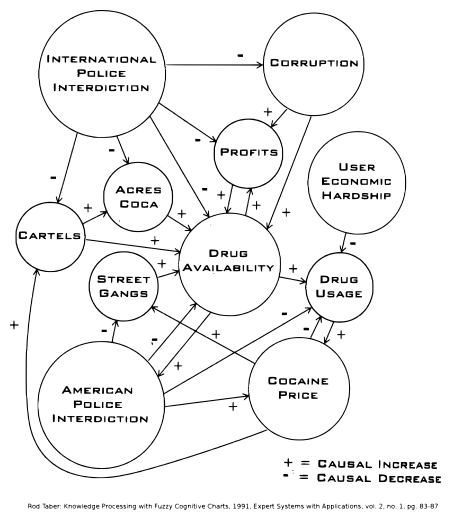
Fuzzy Cognitive Map of the American Drug Market by Rod Taber. From Wikipedia
So Thor She Can Hardly Pith
…that’s what happens when you lose Little Mjolnir.

Mighty Mjolnir, the phallic sym… er, hammer of Thor
Marvel Comics is turning Thor into a woman. As writer Jason Aaron explains –
This is not the Thor we knew transformed into a woman. This is a new character; someone else picking up the hammer… we’ve never seen a big story about a woman picking up the hammer and if you look at the inscription on the hammer it even says, “Whosoever holds this hammer, if he be worthy, shall possess the power of Thor.” I’m going to flip that on its ear and for the first time see what it’s like to have a brand new version of Thor who is female; the Goddess of Thunder… You pick up this book and it just says “Thor” on the cover, which features a new female version of Thor. It’s pretty much telling you she’s not She-Thor or Lady Thor. She’s not Thorika. She is Thor. This is the new Thor.
New Thor. New Coke. It’ll last a while then it will be back to the status quo after the PR buzz wears off.
I’m minimally familiar with Aaron’s work, but I suspect perhaps he feels more comfortable writing female characters. I base this on the one piece of Aaron’s writing that I’ve read, a screed against big-time writer Alan Moore, most famous for the comic series Watchmen in the mid-80s.
When Moore blasted DC Comics for their “Before Watchmen” comics, he stated “When Dave Gibbons phoned me up, he assured me that these prequels and sequels would be handled by ‘the industry’s top-flight talents’. Now, I don’t think that the contemporary industry actually has a ‘top-flight’ of talent. I don’t think it’s even got a middle-flight or a bottom-flight of talent.” Moore was criticizing the endless rehashing of old material into “new” derivative work that didn’t actually bring much of anything new to the table.
Aaron, who had bought everything Alan Moore wrote, as well as “read his novel and listened to his weird CDs” and “envied his beard,” took it quite personally, saying he must have “let the old man down”and that Moore thanked Aaron’s devotion by ” throwing me under the bus,” sounding like a jilted crush even though Moore never mentioned Aaron by name and likely had never heard of him.
Aaron concludes by calling Moore a bitter old man – despite how amazing his beard is – and lobs a final parting shot.
So goodnight Alan Moore, wherever you are. I’d wish you happiness in the New Year, but you probably wouldn’t know what to do with it, would you? Just stay bitter. And those of us in today’s comic industry will stay shitty. And hopefully the two of us will never meet again.
If Aaron hadn’t signed the piece (and ended the closing mini-bio with “His beard is bigger than yours”), this could totally pass for some fangirl blog.
So I can totally understand how Aaron would feel more at home writing “strong, empowered” female characters. I guess it’s supposed to be a step forward for Gender Identity or something by rehashing stories about a male character onto a derivative female one that doesn’t really bring anything new to the table. It reminds me of how the Rick James song “Superfreak” was sampled and looped, the new “song” containing some mediocre lyrics pasted over a repetitive snippet of the original. Hammer Time, indeed.
Somewhat amusing is the concept that Thor’s power resides in his hammer. A woman having to hold her big strong hammer and channeling the power in it strikes me as not quite breaking down those gender barriers. Or maybe it is, in an androgynous sort of way.
I’m not sure what gender warriors will make of the fact that the new female Thor is still dependent on Sugar Daddy Odin the All-Father for her power. Serve that Patriarchy.
Now, I will say that this could be a good storyline. The concept of another person picking up Thor’s hammer isn’t new, and has potential… how would a newcomer deal with the highs and lows of more-or-less being transformed into a god, at least part-time? This kind of idea has been used to good effect in Green Lantern – he’s a member of an intergalactic police force, and got his name and service weapon when the previous officer of that region passed it on right before dying, and later passed it on to someone else in turn. But the entire idea behind the Thor revamp strikes me as a mix of political correctness and cheap shockstunting.
I do agree with John C. Wright that Marvel should at least give this new female Thor a skintight catsuit or chainmail bathing suit.
Leftist Turn At Albuquerque
It started with this post, and led to an argument on CNN about white gay males stealing the culture of black women.
It’s amusing to me how gender is a social construct, and can be changed and transformed at will from one to another (or to made-up ones) but culture and political orientation are hardwired by biology. This neatly sidesteps the issue of whether cultural behaviors can have bad effects, since one can only act according to the culture defined by their color. Anyone imitating a culture outside their race is inauthentic at best and mocking at worst.
I don’t seem to remember Diana Ross, Whitney Houston, or Gloria Gaynor(!) being too upset about gay males buying their albums. Diana Ross even did a song, “I’m Coming Out,” written for her gay fanbase.
Makes ya wonder if Notorious B.I.G., P. Diddy, and Ma$e knew they were sampling a “gay song” when they released “”Mo Money Mo Problems,” or just wanted a catchy beat. Speaking of which, Diddy and Ma$e sure looked like they were borrowing from white culture in the opening of that song’s video. Were they mocking white culture? Or does Diddy just like playing golf?
Ma$e appropriated white culture in his video for “Welcome Back,” borrowing from “Mr. Rogers Neighborhood” and using a sample of the theme song from “Welcome Back Kotter.” Ma$e and Diddy also sampled Latin music culture with “Feel So Good” which used the chorus from Miami Sound Machine’s “Bad Boy.” The song also brags of taking “hits from the 80s.” I think the 80s should sue.
This rabbit hole has no bottom. Where does the line get drawn? Is Eminem a cultural criminal for his plan – in his own words – “To do black music so selfishly / And use it to get myself wealthy”? Dr. Dre didn’t seem to mind too much. What about black rappers who sampled white music? Peter Gunz and Lord Tariq sampled the white boys of Steely Dan (badly) for their song “Déjà Vu (Uptown Baby).” But Steely Dan was influenced by black jazz musicians. Are the black session players who tour with The Dan race traitors? Tariq and Gunz crossed the Latin border when they sampled, in the same song listed above, Latin performer Jerry Rivera’s song “Amores Como El Nuestro” And isn’t “Peter Gunz” a riff on the old TV show with a legendary theme written by a white dude?
I told my wife about the dustup that led off this post. Her response was “Oh, minority victim war.” There are far worse problems facing the black female community than whether Miley Cyrus or gay males are twerking. But that doesn’t get you on CNN.
H/T to Andrew Klavan
Loop Factor Nine
[Or: “Captain Jean-Loop Picard”]
Someone edited a loop of the ambient background sound of the Enterprise-D engines idling. A 24-hour long loop.
Might be good white noise for sleeping.
They Have The Internet On Computers Now!
Teens react to 90s internet –
I’m kinda fond of the 90s internet. Most likely some misplaced nostalgia, I’m sure, but it could also be that Night Sky Radio started streaming online in 1995.* This brings back memories of what the station was like back in those days. Have a look for yourself at the 90s version of Night Sky Radio.
I really miss Geocities. Specifically, the way it was before Yahoo bought it. It had a great theme and actually kinda felt like travelling through different neighborhoods.
* After a, well, let’s call it a spirited discussion with the FCC regarding regular broadcast transmissions. The staff attorneys tell me I can’t say anything further on it.
Baby Maybe
[Or: “Alternative Birthstyle”]
Ryan:(drunk) Sorry…. no no, go go go. Songs of the Chiropractor go back many a many years.
Colin:Do they?
Ryan:Yes they were. And I know as a young black child growing up in the Bronx, none was more popular to me than that boogie-woogie hit, “Is That A Bulging Disc Or Are You Just Happy To See Me?”
Wasn’t it just yesterday that I was saying something about progressives having a “pseudo-intellectual worldview and love of scientific sounding formulas over empirical reality?”
I should have said “terms” instead of “formulas.” With formulas, there’s at least one or two numbers involved, which can be held to some sort of empirical, double-checking standard. Terms sound authoritative and don’t leave the little cracks where factualism can seep in.
Today’s fake-authoritative terminology is “infant gender assignment” –
Obstetricians, doctors, and midwives commit this procedure on infants every single day, in every single country. In reality, this treatment is performed almost universally without even asking for the parents’ consent, making this practice all the more insidious. It’s called infant gender assignment: When the doctor holds your child up to the harsh light of the delivery room, looks between its legs, and declares his opinion: It’s a boy or a girl, based on nothing more than a cursory assessment of your offspring’s genitals.
Because, as everybody knows, doctors have secret special words that magically make their opinions into concrete reality.
It’s getting harder and harder out there for a pseudointellectual pimp. The race to set oneself apart as “enlightened” by discovering deeper and deeper levels of fauxlosophy is barreling toward the horizon at full speed and shows no signs of a finish line.
Hat tip to Bookworm
Rules For Rabbitals
Bugs calls a square-dance tune… [and] redefines the courtship ritual of the dance — a means of channeling and controlling sexual energy — into a fiercely homoerotic ballet.
A Slate article claiming that “Looney Tunes” cartoons were far more brutal than we remember them. James Lileks at National Review concedes the issue, upon the condition that “you’ve had your sense of humor surgically removed, and replaced with an oversized gland that produces chemicals responsible for compulsive frowning.”
What Slate completely missed, and Lileks zeroes in on, is that apparently progressives ran rampant at Warner Brothers studios. Lileks continues, pointing out that the same episode, “Duck! Rabbit, Duck!”
…contains messages that should hearten the heart of a Slate writer, for it contains a very modern message about identity. As you may recall, the plot concerns Fudd’s confusion over which season it is: Wabbit, or Duck? The signage is confusing. Daffy self-identifies as a duck, and this being the ’40s, he is locked in a fixed identity, a product of a culture that says if it walks like a duck and talks like a duck it is a duck. But as we now know, “species” is as fluid as any other form of identity.
And that’s something Bugs reveals in a very subversive sequence. Daffy uses colloquial expressions to describe his mood, noting that he feels like a goat. Whereupon Bugs produces a sign that says it is Goat Season. Fudd unloads accordingly. It may look like violence. But it’s really acceptance. If Daffy says he is a goat then he is a goat. He may suffer the consequences, but Fudd has affirmed his statement of identity. Over the course of the cartoon Daffy identifies with various species, and in each instance Bugs has an appropriate placard to nudge Fudd toward accepting the fluid spectrum on which Daffy may choose to locate himself.
Half a century before Facebook’s 57 genders, Warner Brothers was laying the groundwork.
Read the entire piece, and wonder, “How many times did Bugs do himself up in drag again…?”
Speaking of groundwork…. WB cartoons clearly revealed their pseudo-intellectual worldview and love of scientific sounding formulas over empirical reality throughout the “Foghorn Leghorn” cartoons, where the title character was often shown up by the runty, bespectacled Egghead Jr. –
JLGBTQISMA
– Justice Lesbian Gay Bisexual Transgender Queer Intersex Shapeshifter Mutant Aliens –
Via Ed Trimnell, I tripped over this piece by Damien Walter – Superhero teams. Proof positive that women are at most 25% of the human population. It’s about the underrepresentation of women in superhero comics and movies. to start with, he writes –
…the thing we can rely on every superhero movie for is a balanced and accurate portrayal of gender. Here, have some Avengers.
There 6 Avengers and, look!, only 1 of them is a woman. That’s…er…damn fractions…uhm…about 17%, being generous.
And here’s the Fantastic Four. Looking kind of like dicks. But 1 of the 4 is a woman. That’s 25%!


No compassion for the Hulk or the Thing, who are horribly mutated victims of accidents. Just gender-based bean counting.
After a swipe at the upcoming Guardians of the Galaxy movie (with no mention that while there’s only 1 woman, she’s green – how could he miss that important bit of raising racial awareness?), he adds –
Also worth noting that a variety of male body types are represented – from the endomorphic muscly guy at the front to the ectomorphic tree being at the back – and of course we can assume the diminutive racoon is the clever one. But in all our superhero teams so far the women have essentially identical bodies, trapped in early to mid adolescence, a biological impossibility without severe ongoing dietary restriction. Doubly odd, as none of the male characters appear to be skinny fifteen year olds.
Now, at least Walter has seen the movies, not counting the not-yet-released GOTG. But then he moves on to comics in general. To paraphrase Mark Twain, it seems to me that it was far from right for a writer and columnist for The Guardian to deliver opinions on comics without having read some of them. It would have been much more decorous to keep silent and let persons talk who have read comics.
He starts with the Justice League, who “despite representing a variety of non-terran powers and wielding the power galactic, are, I am told, of America. And yes, 1 woman vs 5 men makes 17% again.”
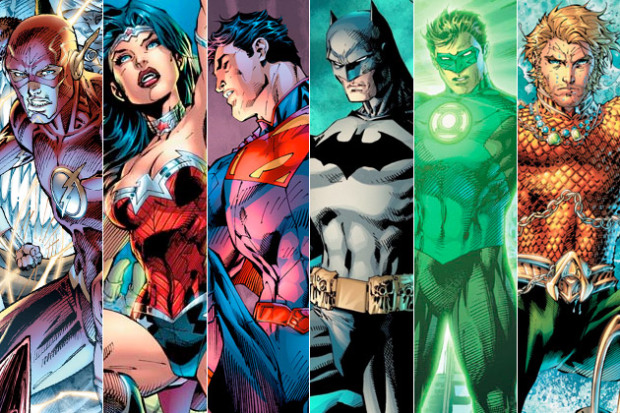
Seems like Walter’s laser-like focus on gender balance may have cost him a boat ticket on the voyage to Diversity. I see three white American males (one from each coast and a midwesterner), but also an Amazon of Greek descent, an Atlantean, and a guy from outer space who lost his entire race in a planetary explosion. I don’t think minority status gets much higher than that. There’s also no mention of the seventh founding member of the JLA – the Martian Manhunter, a green alien from (you’ll never guess) Mars, who happens to be a shapeshifter, and adopted a female form at least twice. Can there be any such thing as gender balance when the entire population can be male or female (or both, or neither, or … other. Facebook would love Martians). Sounds like Mars has achieved a progressive sexual and gender utopia.
During its history, the League has had members who were black, female, a Native American woman, a girl from India, two or three South Americans of both sexes, a Nordic ice goddess, a time traveler, a Russian, a gay Australian furry, alien gods, two sentient androids (one male, one female), a hero who is composed of the merged bodies of two other people, and a bona fide angel. How much more diverse does it get?
Next is the X-Men.

X-Men is sexist, it should be X-People
Now, I’ll give Walter a break here when he writes “I have no idea if this is a representative X-Men line-up.” I don’t think anyone has any idea who is in or out of the X-Men these days, not even the X-Men writers. He also adds “Also I like that picture because of how shifty they all look. Whatever the goal of this mission is , they find it shameful.” Now that’s funny. I’m not sure if “shameful” is the word I would pick – it looks like their mission here is to acquire large quantities of X-Lax with a quickness – but I’ll give him that one… comics art has fallen far from the days when artists could accurately convey expressions.
That said, X-Men was legendary in the 80s and 90s for having strong female characters, especially under the reign of writer Chris Claremont, who wrote Uncanny X-Men and various X-related books from 1975 to 1992, and again in the 2000s. Claremont’s X-books attracted a significant female audience, something few other books have done, and were the best selling comics of the 80s and early 90s, setting sales records. Further, the X-Men were all mutants, and served as stand-ins for pretty much any minority, whether it was race, gender, sexual orientation, the disabled (their leader Professor X was confined to a wheelchair), or even just being a social outcast. Choosing this one team, out of all the comic teams out there, to highlight gender inequality seems spectacularly short-sighted, at the least.
Then we come to The Great Lakes Avengers, which Walter praises (after being assured it’s a real comic and not something a friend of his made up), and this is where his narrow “count-the-boobies” checklist causes him to miss a chance to educate readers about some real Progress in comics –

…do my eyes deceive me…is there a non-anorexic female body type there? Well, yes, although we’ve swung to the far end of the body dysmorphia scale. And for the second time a 33% female line-up!
I’m not sure where he gets 33%. There are five members shown, two of which are female, and both are off-center of the “body dysmorphic scale.” Sounds like 40% to me (the reddish-and-white figure is Dinah Soar, who doesn’t exactly have the standard supermodel measurements. No praise for depicting a differently-physiologied woman who doesn’t have size-DD breasts).
Walter overlooks some diversity fodder here, as Flatman of the Great Lakes Avengers was an early open gay superhero (he came out after another superhero approached the GLA, thinking the acronym stood for Gay/Lesbian Alliance).
The GLA also turned away an applicant named Leather Boy, an S&M enthusiast. The team claimed this was not due to his alternative lifestyle, but because he had no super-powers. This smacks of powers-ism, which is an extreme form of ableism (“If you’re not able to fly or lift a truck, you’re not welcome here.”).
[Side note: The Great Lakes Avengers were created as a joke during a time when rival company DC Comics was making serious bank with their comedy-based Justice League franchise – Justice League America, JL Europe, JL International, JL Antarctica (really!). Holding up the GLA as an example of gender balance is like criticizing the lack of food-themed songs on the radio except for that brave “Weird Al” Yankovic. ]
I’ve never read Great Lakes Avengers. I found all this out with three minutes of internet searches. No reason Walter couldn’t have done the same and learned just how diverse some of these teams really are.
One such team was the 80s series Suicide Squad, which featured as a main character a middle aged overweight black woman named Amanda Waller, nicknamed “The Wall” because she was so tough she put Batman in his place –

The Wall most clearly defies the ” trapped in early to mid adolescence” body type that Walter complained of.
Suicide Squad was absolutely loaded with diversity and badass women –
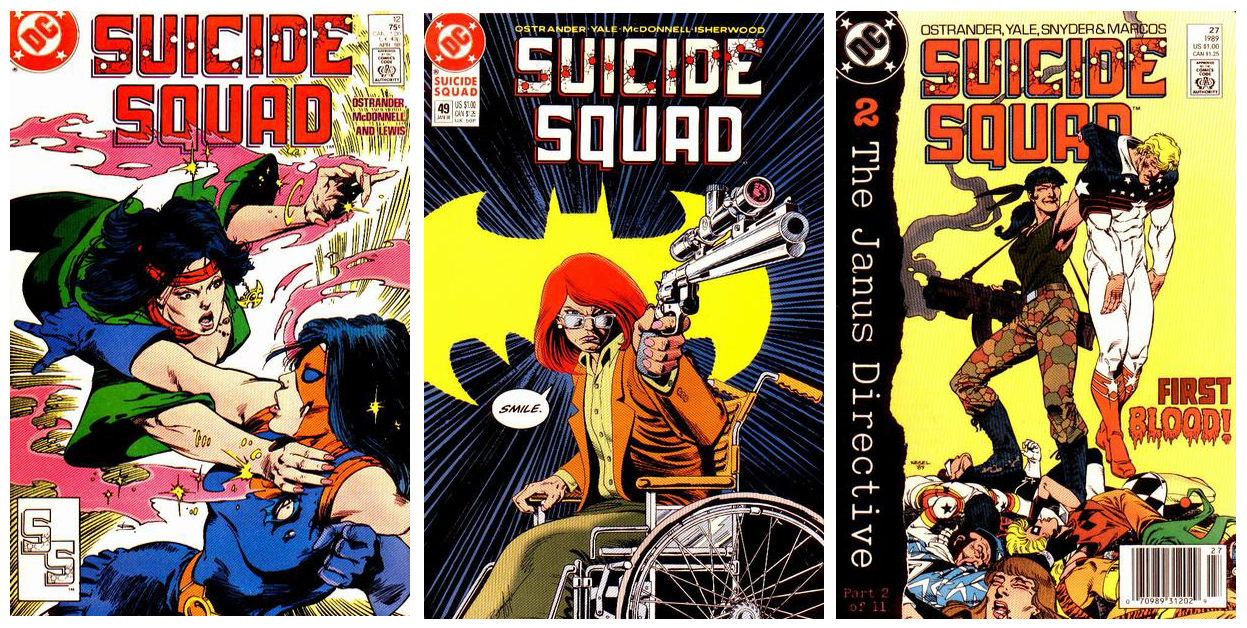
The series also featured a wheelchair bound woman named Barbara Gordon, who was formerly known as Batgirl until she was shot through the spine by the Joker in a story written by Alan Moore. Writer John Ostrander thought this was an opportunity to show a disabled character as more than just a victim of violence and reworked her into the Squad as high-level hacker and information broker Oracle. Unlike the above-noted Professor X, who originated as a disabled character, Oracle was a fully able heroine who was crippled and rebuilt her life.
After Suicide Squad ended in the early 90s (and spending some time in the Justice League to up their diversity quota), Oracle eventually ended up in a new book called Birds Of Prey, focusing in female heroes and villains. Much of the series was written by a woman, Gail Simone, and later issues were drawn by female artist Nicola Scott.
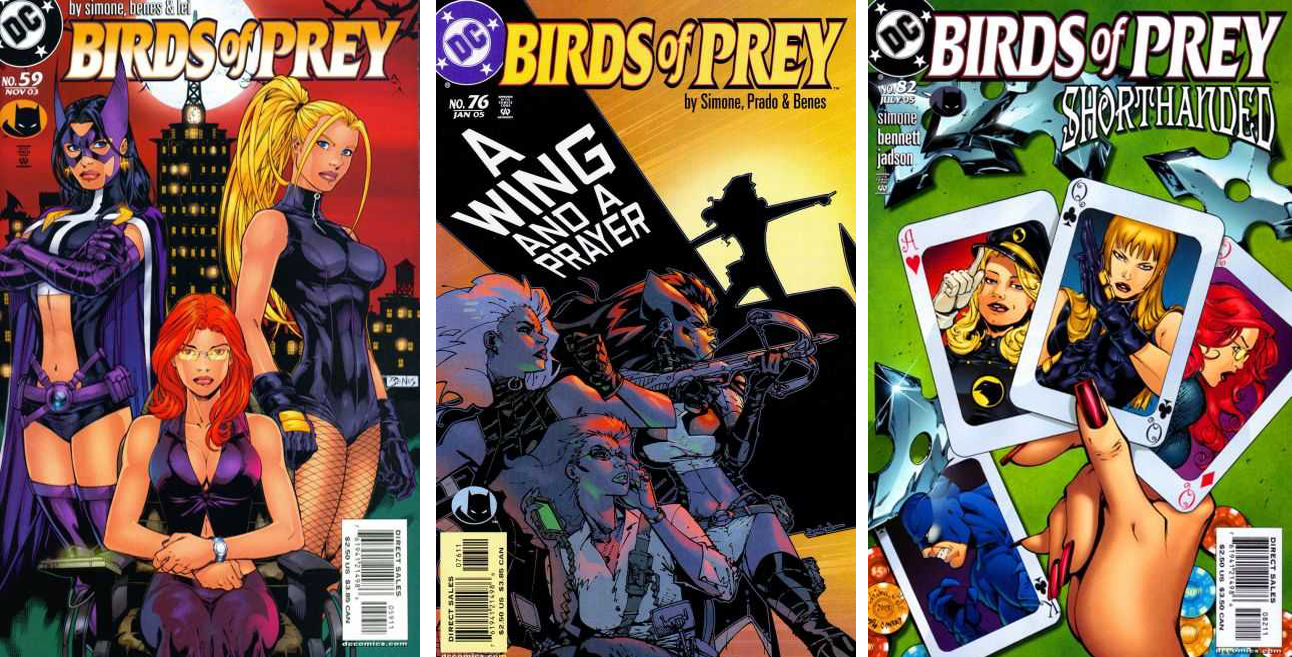
If Walter really wants to write about the lack of diversity in comics, he should look up what happened to Waller and Oracle – Waller has been changed from a self-described “old, fat, angry black woman” into another of the thin, young, generic women he decried in his article (apparently fat-shaming is rampant at DC Comics), while Oracle is up and walking again and back in the Batgirl costume, removing one of the only prominent disabled characters in comics. Or anywhere, really. I’m a little surprised that Walter isn’t aware of at least this seeming strike against diversity and gender balance, since an article about it appeared in The Guardian, where he writes a column (a recent one called for action against the “white maleness of geek culture“). But hey, now there’s a Batgirl comic, so hopefully that counts toward gender balance.
And don’t even get me started on the Doom Patrol.*
I have to wonder why Walter, a writer, doesn’t do more than just talk and do the one thing he’s particularly suited to do in rectifying these perceived gender imbalances – write some female superheroes.
__________________________________
* A leader in a wheelchair, a human brain in a robot body, a transvestite street (!), and a woman who fractured into 64 separate personalities after childhood sexual abuse, each identity with its own unique superpower. Just for openers.
What Kind Of Superman Are You?

It’s International Women’s Day and artist aleXsandro Palombo has done a series called “What Kind Of Man Are You?” featuring images of well-known cartoon characters in scenes of domestic violence.

Characters include Prince Charming and Snow White, The Flintstones, and The Simpsons, among others. I’m not sure what kind of statement he’s trying to make beyond the equivalent of flying a ribbon from your car antenna, but I think he missed the target here. This image, for example…

…isn’t particularly striking, pardon the pun, since we’ve seen Homer do worse to Bart almost since Day One. If anything, Marge is getting off easy (and I seem to recall Maggie launching an unprovoked attack at Homer at one point).
As for the superhero images, they’re pretty tame (seriously, after being hit by Superman, Wonder Woman shouldn’t even have a head anymore). Even the Super Friends cartoon, which looks to be the inspiration here, was more dynamic and energetic. But more importantly, he didn’t need to come up with some new image to show Superman committing domestic violence – there’s tons upon tons of source material in the actual comics.
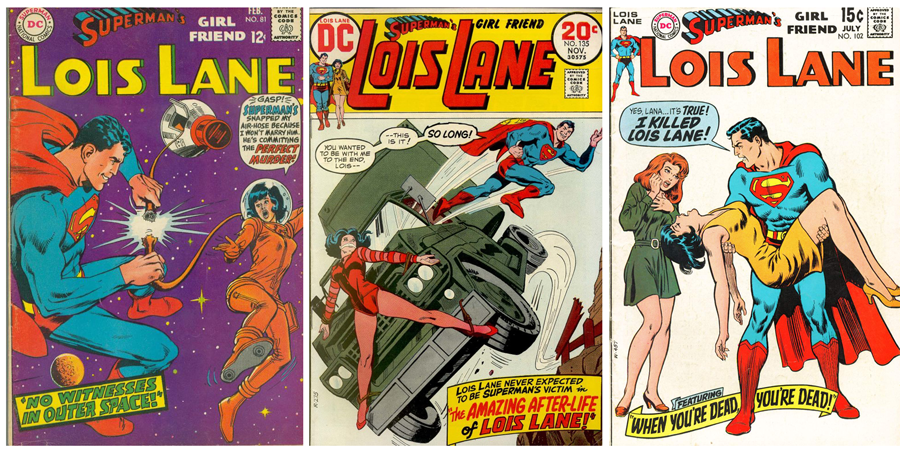
In the end, Superman always wins [click to embiggen]
Those are way niftier ways of trying to murder the one you love, especially if you have super powers. Gotta put some style in your game. But I digress.
So it’s established that Supes was not very nice to his girlfriend. But domestic violence is not always one-sided. Often the woman is an aggressor as well. It’s not as well known because women are generally less likely to manage causing physical harm to the man, which is illuminated through the extreme situation of the Superman-Lois dynamic… what’s she gonna do to him without taking extreme measures?
Which she’s done. Repeatedly. It’s only fair to look at things from Superman’s side of the story and see how Lois has treated him.
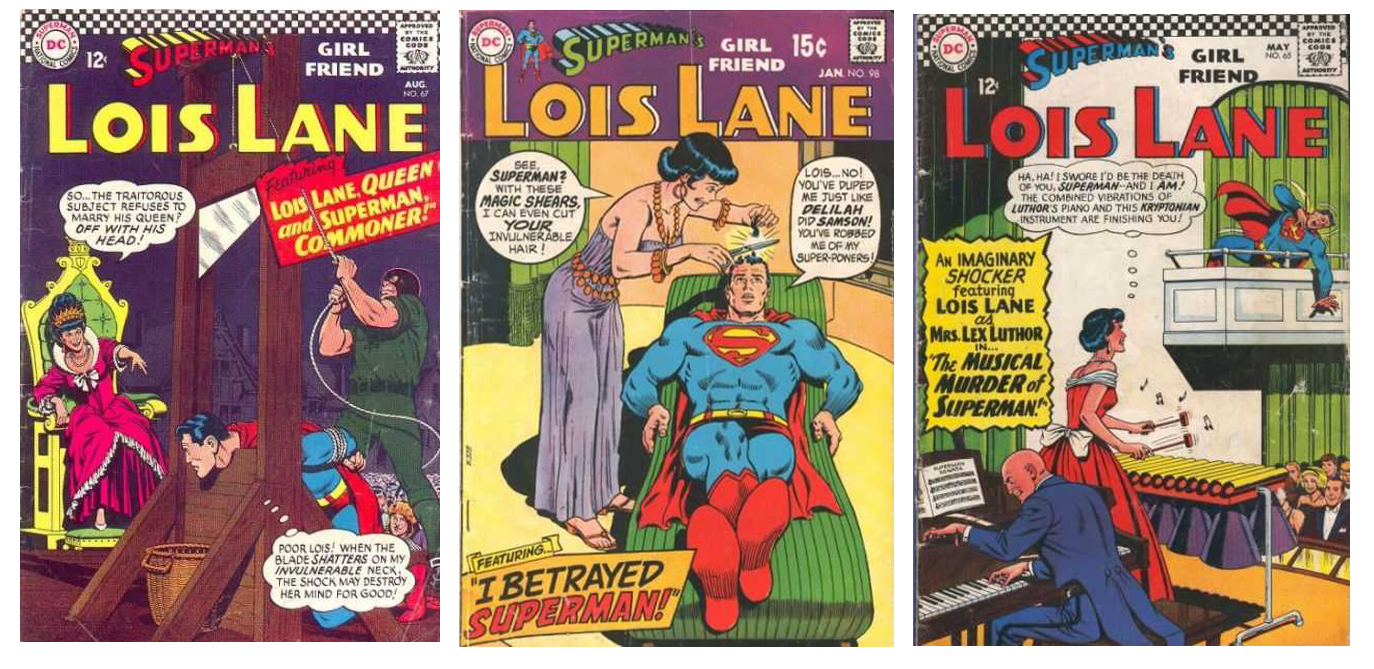
Even Lex Luthor hath no fury like a Lois scorned
Superman isn’t the only one to be the victim of his girlfriend turning on him. Batman’s crazy cat lady squeeze dropped a hurt on him something fierce.

Pussy Riot!!!!
Another aspect of domestic violence that is not often mentioned is that there are times when the woman starts the fight, provoking him into retaliating or sometimes even forcing the man into defending himself. With his greater strength, he is more likely to visibly injure the woman.
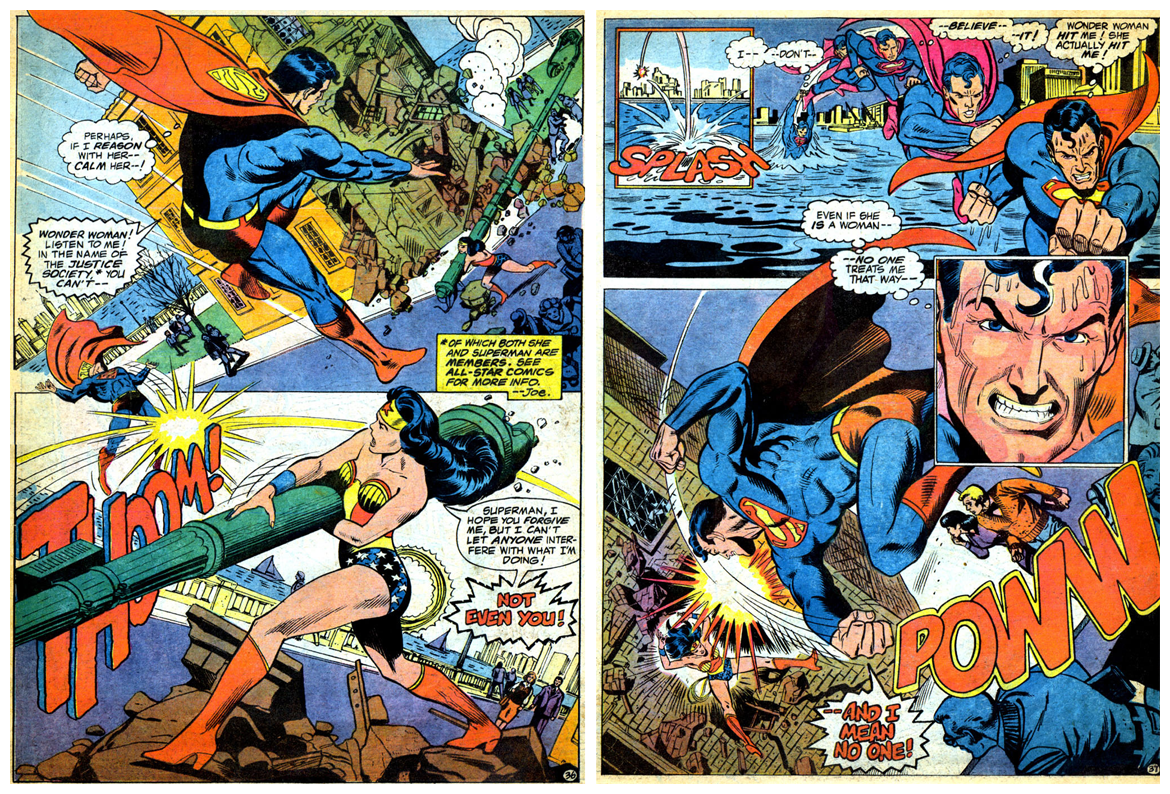
Supes was just wanting to talk til he got bitch-slapped with a light pole. Amazons be crazy, yo
The unstated assumption here appears to be that those with power will abuse it unless shamed into restraining themselves. Delving into characters like these undermines the concept – comics and cartoons are loaded with Women Of Power. Aside from Superman, who is more powerful than Wonder Woman? In addition, unlike the caped Boy Scout, she was explicitly trained to fight and even kill. So should we expect a scene like this?

Steve Trevor and Wonder Woman engage in a little “super power exchange'”
Drink A Cheap@$$ 40 And Let The Hamster Wheel Spin
Kids Prefer Cheese (do hamsters like cheese?) finds a directing sign off the straight and narrow highway –
Does Early Sexual Experience Affect Later Drinking Behavior? In Hamsters.
Um,wait…in hamsters? Seriously. In hamsters.
Perhaps that can be the new tag line for scientists. You know how you are supposed to add “in bed” after a fortune cookie? So, your fortune cookie says “You will soon come into a lot of money” and you add, “in bed!” Hilarity.From now on, medical studies have to end with “in hamsters” to make sure we all understand just how tenuous the conclusions are.
There’s a metaphor in there somewhere but I’ll let someone else make it.
…in hamsters. How do they hold those red Solo cups in their little paws?


 nightskyradio