Blog Archives
The IHOP Is Full
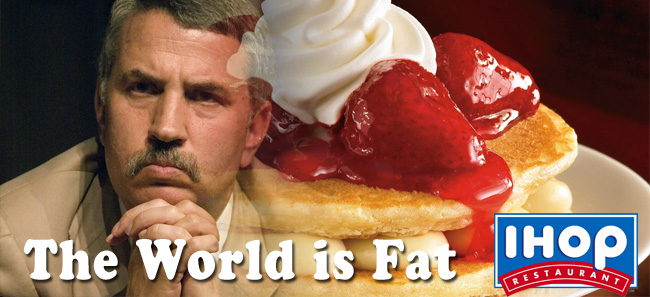
Friedman looks back at the first decade of the 21st century and wonders, “in a world of limited resources, how did I eat that much?”
Thomas Friedman writes for the International House of Pancakes Menu –
In the hyperconnected world we live in, nothing is off limits, which is to say that when the phone rang at the Beijing Hilton I picked up and knew it was one of my Arab friends immediately. “If you have something good,” he said to me, mysteriously, “You can always have something better.” I tapped the message into my notepad app. It was only later, playing golf in the fuzzy green indoor 18 hole arena reserved for visiting businessmen from Europe and America, that I realized what the proverb meant. If you have French toast, stuff it with strawberries and vanilla frosting. If you stuff your French toast, put whipped cream and fruit sauce on top. It’s as simple as that and investments work the same way. I call it the Bettering.

A leading cause of population growth. Taiwanese “big ‘n’ tall” factories are ramping up production
Nobody’s gonna get this but me, probably, but so what?
H/T to Kids Prefer Cheese
Dollars And Centenarys
Today is the 100th anniversary of the day President Woodrow Wilson signed the income tax into law.
I knew I felt kinda down for some reason.
Donald J. Boudreaux of Cafe Hayek asks “Did The Income Tax Lead To Prohibition?” –
Prior to the creation in 1913 of the national income tax, about a third of Uncle Sam’s annual revenue came from liquor taxes. (The bulk of Uncle Sam’s revenues came from customs duties.) Not so after 1913. Especially after the income tax surprised politicians during World War I with its incredible ability to rake in tax revenue, the importance of liquor taxation fell precipitously.
By 1920, the income tax supplied two-thirds of Uncle Sam’s revenues and nine times more revenue than was then supplied by liquor taxes and customs duties combined. In research that I did with University of Michigan law professor Adam Pritchard, we found that bulging income-tax revenues made it possible for Congress finally to give in to the decades-old movement for alcohol prohibition.
Before the income tax, Congress effectively ignored such calls because to prohibit alcohol sales then would have hit Congress hard in the place it guards most zealously: its purse. But once a new and much more intoxicating source of revenue was discovered, the cost to politicians of pandering to the puritans and other anti-liquor lobbies dramatically fell.
Prohibition was launched.
Despite pleas throughout the 1920s by journalist H.L. Mencken and a tiny handful of other sensible people to end Prohibition, Congress gave no hint that it would repeal this folly. Prohibition appeared to be here to stay — until income-tax revenues nose-dived in the early 1930s.
From 1930 to 1931, income-tax revenues fell by 15 percent.
In 1932 they fell another 37 percent; 1932 income-tax revenues were 46 percent lower than just two years earlier. And by 1933 they were fully 60 percent lower than in 1930.
With no end of the Depression in sight, Washington got anxious for a substitute source of revenue.
That source was liquor sales.
We now have a top tax rate of 39.6 percent, and it’s actually much higher than that when you include the impact of other taxes, as well as the pervasive double taxation of saving and investment.
And the relatively simply tax law of 1913 has metastasized into 74,000 pages of Byzantine complexity.
Not to mention that the tax code has become one of the main sources of political corruption in Washington, impoverishing us while enriching the politicians, lobbyists, bureaucrats, and interest groups. Or the oppressive and dishonest IRS.
However, even though I take second place to nobody in my disdain for the income tax, the worst thing about that law is not the tax rates, the double taxation, or the complexity. The worst thing is that the income tax enabled the modern welfare state.
Before the income tax, politicians had no way to finance big government. Their only significant pre-1913 sources of revenue were tariffs and excise taxes, and they couldn’t raise those tax rates too high because of Laffer Curve effects (something that modern-day politicians sometimes still discover).
Once the income tax was adopted, though, it became a lot easier to finance subsidies, handouts, and redistribution.
Pure Progressivism
From Cafe Hayek comes “Rents And Race: Legacies of Progressive Policies” (PDF). The abstract reads –
Could it be that the institutional racism of Jim Crow occurred not despite the Progressive era but because of it? Not only did the Progressive reforms create new economic rents that could be exploited by whites and by the politicians who enacted those reforms, but many leading Progressives espoused views on racial purity and segregation that put them in the vanguard of the American apartheid system.
The authors continue –
Robert Higgs ([1977] 2008) writes that despite racist views by whites and despite the residual interracial violence and discrimination that existed after the Civil War, black Americans made significant economic and social gains. Many of those gains, however, occurred before the onslaught of Progressive economic regulation and the imposition of Jim Crow.Thus, one cannot claim that the institutionalized racism that came with progressivism simply was based on residual racism that existed after the war, as though the racial attitudes of that time inevitably would end in Jim Crow. [1977] 2008. Competition and Coercion: Blacks in the American Economy, 1865–1914. Cambridge, U.K.: Cambridge University Press.]
The Davis-Bacon Act is a pro-union law that discriminates against non-unionized black construction contractors and black workers. In fact, that was the original intent of the Davis-Bacon Act of 1931. During its 1931 legislative debate, quite a few congressmen expressed their racist intentions, such as Rep. Clayton Allgood, D-Ala., who said, “Reference has been made to a contractor from Alabama who went to New York with bootleg labor. This is a fact. That contractor has cheap colored labor that he transports, and he puts them in cabins, and it is labor of that sort that is in competition with white labor throughout the country.”
Random Static Emissions II: Daddy-O In Hell
Mann-made dis-ass-ter
Men hunted the dildo to extinction. Women angry, yet dating more.
“Dildo Extinction” is the greatest name for a hardcore nihilistic death metal band that I’ve ever heard.
The Thigh’s The Limit
Women in Tokyo sell advertising space on their thighs.
Men can finally claim a legitimate excuse for staring. Truly, a major advance in capitalism.
I’m thinking of designing a logo and corporate-branding Allie.
Bringin’ Da Movies
Allamagoosa showed me the movie “Surf Ninjas.” Rob Schneider (who may or may not have a superpower), a cyborg Leslie Nielsen, and Tone Loc on a surfboard [Would that make Nielsen a surfborg?]. Allamagoosa continues her campaign to try to “pay me back” for all the spine-melting music* I make her listen to.
*View at your own risk.
Economics For The Citizen
In 2005, economist Walter Williams of George Mason University wrote ten short essays titled Economics For The Citizen, explaining basic economic concepts for those unfamiliar with them. These should be required reading for everyone. Especially politicians and other know-nothing busybodies who insist on telling people how to do their business. An excerpt –
The essence of exchange is the transfer of title. Here’s the essence of what happens when I buy a gallon of milk from my grocer. I tell him that I hold title to these three dollars and he holds title to the gallon of milk. Then, I offer: If you transfer your title to that gallon of milk, I will transfer title to these three dollars.
Whenever there’s voluntary exchange, the only clear conclusion that a third party can make is that both parties, in their opinion, perceived themselves as better off as a result of the exchange; otherwise, they wouldn’t have exchanged. I was free to keep my three dollars, and the grocer was free to keep his milk. If you think it’s obvious that both parties benefit from voluntary exchange, then how come we hear pronouncements about worker exploitation?
Say you offer me a wage of $2 an hour. I’m free to either accept or reject your offer. So what can be concluded if I’m seen working for you at $2 an hour? One clear conclusion is that I must have seen myself as being better off taking your offer than my next best alternative. All other alternatives were less valuable, or else why would I have accepted the $2 offer? How appropriate is it to say that you’re exploiting me when you’ve given me my best offer? Rather than using the term exploitation, you might say you wish I had more desirable alternatives.
While people might characterize $2 an hour as exploitation, they wouldn’t say the same about $50 an hour. Therefore, for the most part, when people use the term exploitation in reference to voluntary exchange, they simply disagree with the price. If we equate price disagreement with exploitation, then exploitation is everywhere. For example, I not only disagree with my salary, I also disagree with the prices of Gulfstream private jets.
By no means do I suggest that you purge your vocabulary of the term exploitation. It’s an emotionally valuable term to use to trick others, but in the process of tricking others, one need not trick himself.
Pass this along to any recent liberal arts graduates you might know.
King Solomon Had The Right Idea After All
From Reason.com –
Melissa Harris-Perry says that children belong to the community, not their parents.
No, really. I’m not paraphrasing, that’s what she said.
“We have never invested as much in public education as we should have because we have this private notion of children. ‘Your kid is yours, and totally your responsibility.’ We haven’t had a very collective notion of ‘these are our children.’ So part of it is to break through our kind of private idea that kids belong to their parents, or kids belong to their families, and recognize that kids belong to whole communities.
“Once it’s everybody’s responsibility, and not just the household’s, then we start making better investments.”
There’s another video of her at Newsbusters where she dismisses a fertilized egg as nonhuman and opines thusly –
[T]he reality is that if this turns into a person, right, there are economic consequences, right? The cost to raise a child, $10,000 a year up to $20,000 a year. When you’re talking about what it actually costs to have this thing turn into a human, why not allow women to make the best choices that we can with as many resources and options instead of trying to come in and regulate this process?
“I think we have gone through a period when too many children and people have been given to understand ‘I have a problem, it is the Government’s job to cope with it!’ or ‘I have a problem, I will go and get a grant to cope with it!’ ‘I am homeless, the Government must house me!’ and so they are casting their problems on society and who is society? There is no such thing! There are individual men and women and there are families and no government can do anything except through people and people look to themselves first… There is no such thing as society. There is living tapestry of men and women and people and the beauty of that tapestry and the quality of our lives will depend upon how much each of us is prepared to take responsibility for ourselves and each of us prepared to turn round and help by our own efforts those who are unfortunate.”
The Keynes To A Broken Lock
From here –

Applying the multiplier effect to the aggregate demand for broken glass sweep-ups. Because people can never get enough of that
I have to agree with Don Boudreaux at Cafe Hayek that this cartoon is not even a little bit unfair.
Fitting that this is Post #69, since Keynesian economists don’t actually produce anything, but just sit around clumsily making each other feel good.
What’s The Use?
Chateau Heartiste has another “Beta Of The Month” going, with three candidates in the running. Contestant #3, knowing his wife was about to cheat or had already done so, posted –
People are to be LOVED. Things are to be USED. The reason why the world is in chaos is because THINGS are being LOVED and PEOPLE are being used,” the message declares.
Love and use are not mutually exclusive. Years ago, Walter E. Williams wrote –
I’m reminded of charges of exploitation Mrs. Williams used to make early on in our 44-year marriage. She’d charge, “Walter, you’re using me!” I’d respond by saying, “Honey, sure, I’m using you. If I had no use for you, I wouldn’t have married you in the first place.” How many of us would marry a person for whom we had no use? As a matter of fact, the problem of the lonely hearts among us is that they can’t find someone to use them.
So, who’s using you?
Low Grade Politics
Don Boudreaux at Cafe Hayek reports –
WASHINGTON (CH) – In a bold effort to improve the educational fortunes of students who perform at academic levels significantly below the average of their peers, Congress has mandated a minimum grade to be assigned to each student in each course taught at any school in the country. Starting in September, it shall be unlawful for any teacher, professor, or instructor charged with assigning course grades to assign to any student a grade lower than C-.
Sponsors of the Fair Academic Standards Act decry the injustice that occurs each time a student earns a low grade, such as a D or an F. ” It’s impossible for students with ‘D’s and ‘F’s on their transcripts to succeed as they deserve in life,” remarked Sen. Bernie Franken, an Independent from Elitia. ”This law ensures that no American will ever again suffer that hardship.”
…Sen. [Paul] Rand responds by insisting that grades should accurately reflect each student’s actual performance in class. He says that the minimum-grade requirement, to the extent that it doesn’t simply cause academically challenged students to be kept from enrolling in school, will result in report cards and school transcripts that are full of “lies” – grades that do not reflect each student’s actual performance.
…“That accusation is typical of Sen. Rand and his ilk,” alleges Paula Krueger, the influential columnist. ”Sen. Rand is bought and paid for by rich and privileged elites who know that a more fair distribution of school grades will threaten their and their friends’ hold on this country’s levers of power.”
…Not that Ms. Krueger thinks the Act is ideal. ”It’s not perfect. In my view the minimum grade should be much higher. I think A-. And I’d also like to see the minimum grade indexed to grade inflation. That way all students in America, now and in the future, would be exceptionally high-achievers and very well educated.”
Read the entire post.
Capping It Off
Today is the birthday of curmudgeon economist and Djarum Black smoker Captain Capitalism. ‘Tis always fun to see his rants and rails against fluffy-minded liberal “thinkers.”
He promised me several kilos and enough hookers to snort it all off of in exchange for the pimpage. I expect delivery by Saturday.


 nightskyradio