Author Archives: Night

Boombox Superblast Mixtape
All kinds of science in the news right now. From Gizmodo – the 185 terabyte casette tape.
Stupid hipster 80s fetishism notwithstanding, cassette tapes don’t get much love. That’s a shame, because magnetic tape is still a surprisingly robust way to back up data. Especially now: Sony just unveiled tape that holds a whopping 148 GB per square inch, meaning a cassette could hold 185 TB of data. Prepare for the mixtape to end all mixtapes.
Sony’s technique, which will be discussed at today’s International Magnetics Conference in Dresden, uses a vacuum-forming technique called sputter deposition to create a layer of magnetic crystals by shooting argon ions at a polymer film substrate. The crystals, measuring just 7.7 nanometers on average, pack together more densely than any other previous method.
The result: three Blu-Rays’ worth of data can fit on one square inch of Sony’s new wonder-tape.
John Hayward immediately sees the possibilities, lamenting that such a technology was not available in bygone days…
Shooting argon ions into a polymer substrate? It seems so obvious in retrospect. Why weren’t we doing that back when Flock of Seagulls was big? We could have made one mix tape that would sit in our car stereos until it melted.
But there are downsides. As one commenter put it, “I can’t imagine REWINDING 185 TB of data.”
I would have loved to have HD cassette tapes back in the days before CD burning was an option. And imagine the street cred of having a boombox capable of playing around 61,697,500-song mixtapes. Epic rap battles would erupt among DJ street fighters.

PRESS TO PLAY
The House Edge
From the bleeding edge of house technology (no, not the music)… A Chinese construction firm 3D printed 10 small houses a one day using a process called “contour crafting” on a large scale.
I wouldn’t have wagered on the claim that the houses cost only $5000 each, but after seeing the result, I can believe it. Not exactly stately Wayne Manor here, but it looks livable enough.

Now it just needs life size, 3D printed Ken & Barbie
And from here – “Professor Behrokh Khoshnevis of The University of Southern California is testing a giant 3D printer that could be used to build a whole house in under 24 hours.”
Contour Crafting could slash the cost of home-owning, making it possible for millions of displaced people to get on the property ladder. It could even be used in disaster relief areas to build emergency and replacement housing. For example, after an event such as Typhoon Haiyan in the Philippines, which has displaced almost 600,000 people, Contour Crafting could be used to build replacement homes quickly.
It could be used to create high-quality shelter for people currently living in desperate conditions. “At the dawn of the 21st century [slums] are the condition of shelter for nearly one billion people in our world,” says Khoshnevis, “These buildings are breeding grounds for disease a problem of conventional construction which is slow, labour intensive and inefficient.”
If Khoshnevis wins his bet, this could lower housing costs to a fraction of what it costs now, and allow buyers vast leeway in choosing specifications. Why, one could design their very own life-sized Malibu Stacy’s Dream House.
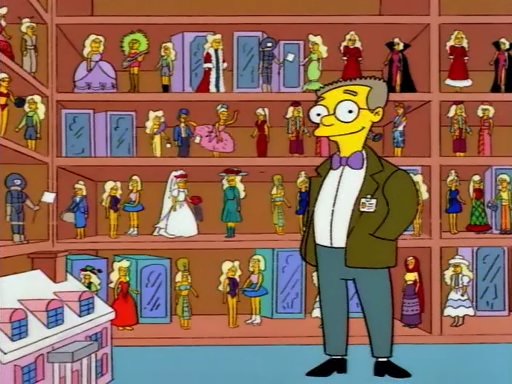
Life is gay and fancy-free, when you’re with Malibu Stacy
Oops! Pretend you didn’t see that. Look at this one instead.

“Who cares if she has a new hat?!?”
JLGBTQISMA
– Justice Lesbian Gay Bisexual Transgender Queer Intersex Shapeshifter Mutant Aliens –
Via Ed Trimnell, I tripped over this piece by Damien Walter – Superhero teams. Proof positive that women are at most 25% of the human population. It’s about the underrepresentation of women in superhero comics and movies. to start with, he writes –
…the thing we can rely on every superhero movie for is a balanced and accurate portrayal of gender. Here, have some Avengers.
There 6 Avengers and, look!, only 1 of them is a woman. That’s…er…damn fractions…uhm…about 17%, being generous.
And here’s the Fantastic Four. Looking kind of like dicks. But 1 of the 4 is a woman. That’s 25%!


No compassion for the Hulk or the Thing, who are horribly mutated victims of accidents. Just gender-based bean counting.
After a swipe at the upcoming Guardians of the Galaxy movie (with no mention that while there’s only 1 woman, she’s green – how could he miss that important bit of raising racial awareness?), he adds –
Also worth noting that a variety of male body types are represented – from the endomorphic muscly guy at the front to the ectomorphic tree being at the back – and of course we can assume the diminutive racoon is the clever one. But in all our superhero teams so far the women have essentially identical bodies, trapped in early to mid adolescence, a biological impossibility without severe ongoing dietary restriction. Doubly odd, as none of the male characters appear to be skinny fifteen year olds.
Now, at least Walter has seen the movies, not counting the not-yet-released GOTG. But then he moves on to comics in general. To paraphrase Mark Twain, it seems to me that it was far from right for a writer and columnist for The Guardian to deliver opinions on comics without having read some of them. It would have been much more decorous to keep silent and let persons talk who have read comics.
He starts with the Justice League, who “despite representing a variety of non-terran powers and wielding the power galactic, are, I am told, of America. And yes, 1 woman vs 5 men makes 17% again.”

Seems like Walter’s laser-like focus on gender balance may have cost him a boat ticket on the voyage to Diversity. I see three white American males (one from each coast and a midwesterner), but also an Amazon of Greek descent, an Atlantean, and a guy from outer space who lost his entire race in a planetary explosion. I don’t think minority status gets much higher than that. There’s also no mention of the seventh founding member of the JLA – the Martian Manhunter, a green alien from (you’ll never guess) Mars, who happens to be a shapeshifter, and adopted a female form at least twice. Can there be any such thing as gender balance when the entire population can be male or female (or both, or neither, or … other. Facebook would love Martians). Sounds like Mars has achieved a progressive sexual and gender utopia.
During its history, the League has had members who were black, female, a Native American woman, a girl from India, two or three South Americans of both sexes, a Nordic ice goddess, a time traveler, a Russian, a gay Australian furry, alien gods, two sentient androids (one male, one female), a hero who is composed of the merged bodies of two other people, and a bona fide angel. How much more diverse does it get?
Next is the X-Men.

X-Men is sexist, it should be X-People
Now, I’ll give Walter a break here when he writes “I have no idea if this is a representative X-Men line-up.” I don’t think anyone has any idea who is in or out of the X-Men these days, not even the X-Men writers. He also adds “Also I like that picture because of how shifty they all look. Whatever the goal of this mission is , they find it shameful.” Now that’s funny. I’m not sure if “shameful” is the word I would pick – it looks like their mission here is to acquire large quantities of X-Lax with a quickness – but I’ll give him that one… comics art has fallen far from the days when artists could accurately convey expressions.
That said, X-Men was legendary in the 80s and 90s for having strong female characters, especially under the reign of writer Chris Claremont, who wrote Uncanny X-Men and various X-related books from 1975 to 1992, and again in the 2000s. Claremont’s X-books attracted a significant female audience, something few other books have done, and were the best selling comics of the 80s and early 90s, setting sales records. Further, the X-Men were all mutants, and served as stand-ins for pretty much any minority, whether it was race, gender, sexual orientation, the disabled (their leader Professor X was confined to a wheelchair), or even just being a social outcast. Choosing this one team, out of all the comic teams out there, to highlight gender inequality seems spectacularly short-sighted, at the least.
Then we come to The Great Lakes Avengers, which Walter praises (after being assured it’s a real comic and not something a friend of his made up), and this is where his narrow “count-the-boobies” checklist causes him to miss a chance to educate readers about some real Progress in comics –

…do my eyes deceive me…is there a non-anorexic female body type there? Well, yes, although we’ve swung to the far end of the body dysmorphia scale. And for the second time a 33% female line-up!
I’m not sure where he gets 33%. There are five members shown, two of which are female, and both are off-center of the “body dysmorphic scale.” Sounds like 40% to me (the reddish-and-white figure is Dinah Soar, who doesn’t exactly have the standard supermodel measurements. No praise for depicting a differently-physiologied woman who doesn’t have size-DD breasts).
Walter overlooks some diversity fodder here, as Flatman of the Great Lakes Avengers was an early open gay superhero (he came out after another superhero approached the GLA, thinking the acronym stood for Gay/Lesbian Alliance).
The GLA also turned away an applicant named Leather Boy, an S&M enthusiast. The team claimed this was not due to his alternative lifestyle, but because he had no super-powers. This smacks of powers-ism, which is an extreme form of ableism (“If you’re not able to fly or lift a truck, you’re not welcome here.”).
[Side note: The Great Lakes Avengers were created as a joke during a time when rival company DC Comics was making serious bank with their comedy-based Justice League franchise – Justice League America, JL Europe, JL International, JL Antarctica (really!). Holding up the GLA as an example of gender balance is like criticizing the lack of food-themed songs on the radio except for that brave “Weird Al” Yankovic. ]
I’ve never read Great Lakes Avengers. I found all this out with three minutes of internet searches. No reason Walter couldn’t have done the same and learned just how diverse some of these teams really are.
One such team was the 80s series Suicide Squad, which featured as a main character a middle aged overweight black woman named Amanda Waller, nicknamed “The Wall” because she was so tough she put Batman in his place –

The Wall most clearly defies the ” trapped in early to mid adolescence” body type that Walter complained of.
Suicide Squad was absolutely loaded with diversity and badass women –
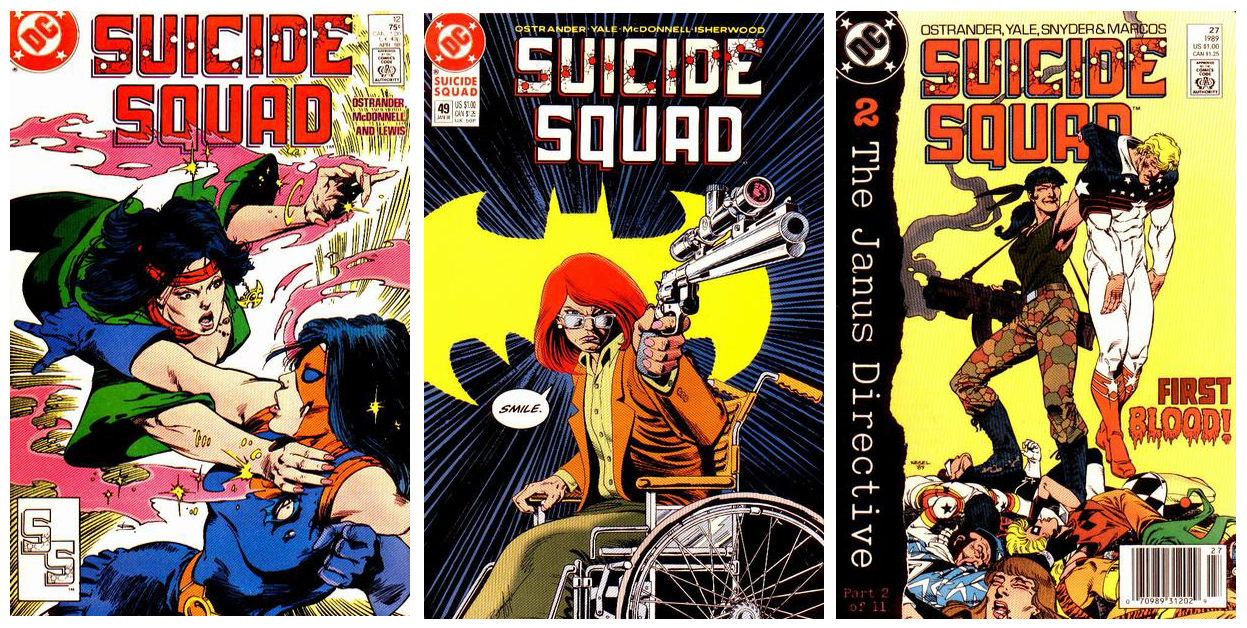
The series also featured a wheelchair bound woman named Barbara Gordon, who was formerly known as Batgirl until she was shot through the spine by the Joker in a story written by Alan Moore. Writer John Ostrander thought this was an opportunity to show a disabled character as more than just a victim of violence and reworked her into the Squad as high-level hacker and information broker Oracle. Unlike the above-noted Professor X, who originated as a disabled character, Oracle was a fully able heroine who was crippled and rebuilt her life.
After Suicide Squad ended in the early 90s (and spending some time in the Justice League to up their diversity quota), Oracle eventually ended up in a new book called Birds Of Prey, focusing in female heroes and villains. Much of the series was written by a woman, Gail Simone, and later issues were drawn by female artist Nicola Scott.

If Walter really wants to write about the lack of diversity in comics, he should look up what happened to Waller and Oracle – Waller has been changed from a self-described “old, fat, angry black woman” into another of the thin, young, generic women he decried in his article (apparently fat-shaming is rampant at DC Comics), while Oracle is up and walking again and back in the Batgirl costume, removing one of the only prominent disabled characters in comics. Or anywhere, really. I’m a little surprised that Walter isn’t aware of at least this seeming strike against diversity and gender balance, since an article about it appeared in The Guardian, where he writes a column (a recent one called for action against the “white maleness of geek culture“). But hey, now there’s a Batgirl comic, so hopefully that counts toward gender balance.
And don’t even get me started on the Doom Patrol.*
I have to wonder why Walter, a writer, doesn’t do more than just talk and do the one thing he’s particularly suited to do in rectifying these perceived gender imbalances – write some female superheroes.
__________________________________
* A leader in a wheelchair, a human brain in a robot body, a transvestite street (!), and a woman who fractured into 64 separate personalities after childhood sexual abuse, each identity with its own unique superpower. Just for openers.
Tomorrow’s Annual Xtortion
Swiped taxed from Ed Driscoll, ReasonTV busts out a jam –
For those who kick it old skool and the only Pharrell you know is the guy who played BJ on M*A*S*H…
The Low Rider Is Revving In The Drive
Listen and compare basslines –
There’s even some similarity between the opening drum rolls.
Actual video here, I used the other one because this version skips over the opening drums.
I was something of a Thompson Twins fan when I was in junior high. I had the records Side Kicks and Into The Gap (on vinyl), and I think I had some 12″ remix album of “In the Name Of Love.” While I didn’t collect clippings or anything like that, I did read pieces about them in music magazines when I was in a store. I was rather into New Wave thanks to MTV.
I pretty much lost interest in the band not too long afterward, partly because their new single “Lay Your Hands On Me” sucked, and whatever residual interest I had in checking out their new album was likely snuffed by this. I suspect that it also helped kill their careers as well.
One Day My Plane Leaves

Crying rhymes for the dying times
If it’s time to die there’s nothing you can do
– Second Coming with Layne Staley, “It’s Coming After”
Kurt Cobain wasn’t the only musician from the early 90’s “Seattle Scene” to die at a young age.
In 2002, eight years after Cobain’s death, Layne Staley of Alice In Chains died, after years and
years of drug abuse.
Like Kurt, no one knows the exact date of his death for certain, and like Kurt, his death was
ruled to have happened on April 5. I’ve always wondered if the coroner or whoever chose that date
for some kind of symbolic reason.
Very much unlike Kurt, however, Layne didn’t suddenly and shockingly die at the height of his fame. Rather, everyone knew he was heading for a pine box for a number of years before it finally happened. A good number of his lyrics even seemed to evidence that Layne himself knew this. But while he was here, his voice coupled with Jerry Cantrell’s nuclear-blast music brought a heavy, sludgy, dark sound not like anything up to that point.
Layne had a couple of side projects, one of which was occasionally guest-singing with the band Second Coming. Another better known one was collaborating with members of Pearl Jam and Screaming Trees in the supergroup-of-sorts Mad Season. Anyone who knew Layne (aka “The Voice Of Doom”) only from AIC and thought his sole talent was screaming was thoroughly disabused of that notion.
From 1995, a full seven years before his death, but it sounded like he knew it was already over, didn’t he?
Layne could also play drums and was (I’m speculating here) a bit of “Benny Hill” fan.
According to Wikipedia, “At Alice in Chains’ last concert with Staley on July 3, 1996, they
closed with ‘Man in the Box.'” How disturbingly appropriate.
Title is from this song, lyrics and music entirely by Layne as well as playing rhythm guitar… loudness warning, but it’s awesome –
Buy Our Album! We’re Nirvana!
Our little group has always been
And always will until the end
It’s 20 years today since Kurt Cobain died. There’s still argument over whether it was a suicide or not.
I didn’t get into Nirvana’s music right off the bat, but I did like “Smells Like Teen Spirit,” and once I dived into alternative music, they were right up there. They were one of those bands where I hated some of there songs and loved others … not a lot of middle ground. At first, I thought they were going to be the next fad, maybe be a big name band. Like everyone else, I had NO idea just how big they were gonna be. I don’t think I’ve seen anything else quite like it in my lifetime.
People just could not get enough of that song. It was everywhere. I think it inspired more people to pick up guitars than anyone since the Beatles, or maybe even since Elvis.
I wasn’t one of them. I had wanted to play music since before that, and didnt pick up guitar until well after Kurt was dead. But Nirvana was definitely a strong influence. Some of the first songs I learned to play on guitar were Nirvana tunes. Let’s face it – solos aside, a lot of them aren’t that difficult once you master power and barre chords. They are, however, teriffically arranged power and barre chords.
Reportedly, Kurt claimed that he knew he had “made it” when Weird Al Yankovic parodied one of his songs. To hear Al himself tell it –
For whatever reason, my manager tried and tried and said he couldn’t get through [to Nirvana]. He contacted them again and again and they never got back to him. So he said, “If you want to do this parody, it’s on you. You’ve gotta talk to the band.” A friend of mine was in the cast of Saturday Night Live [UHF co-star Victoria Jackson]. I told her, if you ever get Kurt Cobain alone in a room, put him on the phone, because I’d love to talk to him — and she did! Directly! He was sweet and he got it in like five seconds and said, “Of course you can do a parody.” The famous quote from him was, “Is it going to be a song about food?” because at that point that’s primarily what I was known for. And I said, “Well, no, it’s going to be a song about how nobody can understand your lyrics.” And he said, “Oh, sure, of course, that’s funny.”
Yankovic also stated –
It was exceptionally hard shortly after Kurt passed. It was still my biggest hit at the time, and I couldn’t not do it because the fans would want to hear it, but at the same time, it was uncomfortable for me, especially. So for a long time after Kurt passed, I would always preface my performance of the song by doing a somber dedication to Kurt in his memory. The hardest one was doing Seattle, because I didn’t know if I should be doing that song in Seattle at the time. I didn’t know how people would take it. I asked a lot of journalists there, “Should I do this? Should I not do this?” And almost unanimously they said, “You should do this. It would be cathartic.” And it actually went over extremely well.
I don’t remember where I was when I found out Kurt had died or anything like that. I’m not a hardcore fan keeping vigils or whatever. But I have always been a bit fascinated by him and the band, and sometimes pick up the odd and random bit or piece of history I trip across.
Endless Days Of Dark Knights
 Batman is 75 years old today, first appearing in Detective Comics #27, which hit newsstands onMarch 30th, 1939. Along with Superman, he is one of the longest running continuing characters to be published without interruption, something that had never been done before or since (although Wonder Woman is set to hit 75 in a couple of years).
That said, he looks pretty young for his age.

From the webcomic JL8
This is the guy who ninja-trained Roissy.
Remember the days when it was the Superman movies that were awesome and the Batman movies… not so much? Now The Dark Knight is the height of excellence.
Mo’ Money, No Problems
[Or: “Dullards And Centslessness”}
Found via VodkaPundit – “Stop freaking out about the debt”
Matt Yglesias narrates a short video claiming that the debt is not a problem right now. As VP noted, Yglesias actually states “The US government can never run out of dollars.”
See, the federal government prints dollars, or the Federal Reserve makes them on computers. Why people shouldn’t worry about the feds creating money on computers but are supposed to throw crosses and holy water at Bitcoin is not explained.
The video also states that the debt could be reduced through higher taxes or cutting benefits, but that would be taking money out of people’s pockets. Higher taxes do take money out of people’s pockets, but cutting benefits does not. It’s reducing the amount of money going into people’s pockets. One can argue the ethics or the costs of cutting benefit payouts, but let’s call it what it is.
The video concludes by asking viewers to find something else to worry about, because “debt just isn’t a problem right now.” Why change the oil in your car now when you can let the engine seize up later?


 nightskyradio