Blog Archives
Flash Drive Bullets
So I was reading this post by Elusive Wapiti, where he discusses assault weapons bans and totalitarianism. Good post, go read it. It’s about digitally fabricating guns, and how efforts are already underway to outlaw it. As usual, the self-anointed Guardians of Society build a house on a foundation of sand – the best way to ensure the safety of law-abiding citizens is not to disarm them, leaving them at the mercy of the lawless. Rather, if everyone has access to a gun, and knows that everyone else around him could be carrying as well, the chances of assault drop dramatically. But there’s a lot more going on here than a statist power grab.
A group named Defense Distributed is designing digital blueprints for firearms for 3D printing. The goal is to create a file via 3D modeling which can be distributed, and a working gun printed for anyone who wants it.
They sum up their goals, and the potential impact –
Insofar as possible, we hope to facilitate a printable firearm creative commons. Our weapons project’s namesake, a “wiki” is likely the best platform for preserving and collaboratively producing knowledge related to 3D printable firearms for years to come.
…This project might change the way we think about gun control and consumption. How do governments behave if they must one day operate on the assumption that any and every citizen has near instant access to a firearm through the Internet? Let’s find out.
I like funny cat videos as much as anyone else, but we’ve barely scratched the surface of what the internet is capable of. Printable guns! Store ammo files on your flash drive. And that’s just the beginning. There may come a day when 3D printers are capable of producing organic structures – people could keep digital scans of their bodies – including MRIs – on file. If they suffer an accident, replacement parts could be printed out, such as a new heart. Or new lungs for smokers. Lose a few teeth in a bar fight? Dental records on your phone. Your body could be scanned at age 20 and kept on file until you’re 50 and take a trip to Posh de Leon’s Fountain Of Youth and Rejuvenation Spa.
Some people are not too happy about this, however. As National Review writes –
The idea of crowd-sourced plastic rifles and pistols being zapped into existence, Weird Science–style, in workshops and garages across the nation unnerves Representative Steve Israel (D., N.Y.) — so much so that he’s sponsoring an amendment to the Undectectable Firearms Act in order to regulate 3-D-printed gun components and establish penalties for their private fabrication. But as others have pointed out, such a law would be a nightmare to enforce.
The utter lack of imagination among bureaucrats and progressive types (but I repeat myself) is stupefying. Not only do they not have the capacity to remotely visualize the possibilities such technology offers, but they make heavy-handed, short-sighted attempts at regulating or even outlawing it –
In an effort to outflank the likes of DD, a zealous government could move to mandate that manufacturers design 3-D printers to leave secret, unique watermarks on every object fabricated, as the Secret Service convinced manufacturers of color laser printers to do in an effort to catch currency counterfeiters. But technological control begets technological revolt: The secret laser-printer codes were discovered and revealed by a digital-rights group in 2005, and their existence prompted a public outcry. Besides, what good is a watermark when a 3-D assembler can assemble another 3-D assembler? [emphasis mine]
Seriously. It’s like filing off the serial numbers, but better. Make a new assembler. Or two. Or three. Destroy the original. Start a black market selling illegal, untraceable 3D printers along with all the other cool things you’re designing. Pair this up with an alternative currency like Bitcoin (I noticed one of the people on DD’s “About” page has some experience with it) and who knows what could happen? This could spark a tectonic shift in economic systems.
It looks like they’re running all this super-ultra-high-tech with Windows XP, which cracks me up.

Pranking will become a High Art
Ceres Mining Station
Every so often, almost like clockwork, the story goes around that natural resources are running out. In 1968, Paul Erlich published The Population Bomb, in which he claimed
The battle to feed all of humanity is over. In the 1970s hundreds of millions of people will starve to death in spite of any crash programs embarked upon now. At this late date nothing can prevent a substantial increase in the world death rate…
I’m sure you all vividly remember the huge population drop in the 70s. Hundreds of millions of people died as predicted, and worse, thousands of pizzerias closed their doors. [The government tried to blame the deaths on mass suicides to escape disco music.]
In 1980, Julian Simon – who stated the human mind the “ultimate resource” and that there are no natural resources until humans figure out a way to use them – called Erlich out. They wagered on whether the prices of five metals would rise or fall by 1990. Simon won the bet.
Some have claimed that if the bet had been longer, or for a different time frame, Ehrlich would have won. Tim Worstall of Forbes explains why this isn’t so –
The end result of all of this is that yes, it is true that Ehrlich could have, would have, won the bet depending upon the starting date. But note that it would have been either political actions, or teething problems with new technology, that would have allowed that. None of these metals faces an actual shortage as yet. Further, note that over variable time scales Simon is still correct: it really is true that new technologies of extraction are developed and these increase supply and push prices down.
Oil is a perfect example of how human innovation transforms worthless material into valuable resources. Alex Epstein wrote –
It is almost impossible to overstate the dramatic and near-immediate positive effect of a group of scientists and businessmen discovering that “rock oil,” previously thought to be useless, could be refined to produce kerosene—the greatest, cheapest source of light known to man. In 1858, a year before the first oil well was drilled, only well-to-do families such as that of 11-year-old Henry Demarest Lloyd could afford sperm whale oil at three dollars per gallon to light their homes at night.
The “teething problems with new technology” plagued the early business of kerosene – fires and explosions were not uncommon. Standard Oil owner John D. Rockefeller innovated numerous methods of improving efficiency, such as transporting oil in tank cars instead of filling railroad cars with barrels. Chemist Samuel Andrews refined Standard Oil’s formula for purifying distilled kerosene. Costs went down, not only for Standard Oil, but for everyone else too. The price of kerosene dropped by more than half – from fifty-eight cents in 1865 to twenty-six cents in 1870.
Chris Mayer of The Daily Reckoning quotes Joseph Schumpeter and makes his prediction for 2013 –
The great economist Joseph Schumpeter’s (1883-1950) criticism of the Malthusian position still holds. On Malthus and his ilk, he wrote: “The most interesting thing to observe is the complete lack of imagination which that vision reveals. Those writers lived at the threshold of the most spectacular economic developments ever witnessed.” Yet they missed it.
So here is my prediction: I believe we are on the cusp of even greater levels of innovation and development — another industrial revolution is in progress right now.
I think he’s right. Deep Space Industries just announced their plan to send out spacecraft called “Fireflies” into space to seek out resources for exploitation (no word yet on whether River Tam will be aboard). And they aren’t the first. Last year, Planetary Resources announced a similar undertaking. Rand Simberg raised a question at Deep Space Industries recent press conference
Is there room for two such companies? At the press conference, I asked if they saw themselves as complementary to, or in pure competition with PR.
“We love Planetary Resources,” said Rick Tumlinson, chairman of the board. “One company may be a fluke, but two companies showing up, that’s the beginning of an industry.”
Don’t believe anyone who claims the future is all doom and gloom. The future may not be all sunshine and flowers, there are far too many Black Swans in the water to just assume it’s all downhill from here.
Spinning The Wheels
Russ Roberts of Cafe Hayek discovers the rationalization hamster of economists –
We get the economics that’s in demand, the economics that people want. It’s the reverse of the Keynes argument about the influence of defunct economists. Keynes saw economics ideas influencing policy. But maybe it is policy that influences economics. So as the world becomes more interventionist, the economists respond by finding arguments that rationalize that policy.
…In this view, economists are not truth-seekers. They are producers of ideas who respond to market demand. So when the financial crisis comes in 2008 and everyone wants something to be done about it, suddenly, Keynesianism is obviously the right intellectual choice for hundreds of academics and bloggers who hadn’t given it much thought or if they had, they had rejected it previously.
Our product, the less interventionist, liberty product, is in demand but not nearly as popular. People generally don’t want to trust unseen, spontaneous order-based solutions that rely on invisible hand processes. They don’t trust solutions without top-down control–they are not as reassuring. Most people are eager to trust a person who says they care about them than they do a process they are unlikely to fully understand.
Perhaps we could name this pet hamster “Maynard.”
…And Scrooge McDuck Isn’t Paying His Fair Share
This sums up our Mickey Mouse government perfectly.
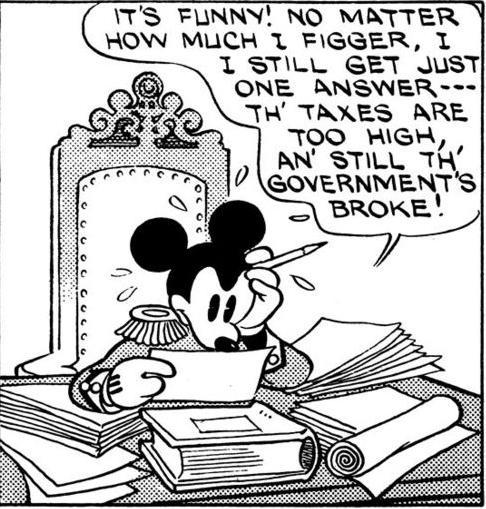
From the MM newspaper strip, “The Monarch of Medioka” circa 1937, which was censored in Yugoslavia.
The Future Never Was What It Used To Be
Found this through Cafe Hayek – Why Do Futurists Get So Much Wrong?
The Austrian economist Ludwig Lachmann once walked into the colloquium room at New York University, where the blackboard displayed this quotation: “When it comes to the future, one word says it all: You never know. – Y. Berra.”
Having built much of his economics on the unknowability of the future, Lachmann noticed the quote. However, having lived in South Africa for decades and being unfamiliar with the wit and wisdom of the former New York Yankees catcher, he pondered the chalk inscription for a bit, turned to those assembled, and in his heavy accent said, “I’m afraid I’m not familiar with the works of Professor Berra.”
When Black Friday Comes…
…I’ll rush right through the door
Running from aisle to aisle
Blue Light Special on the sales floor
They could rewrite the song from a stock market crash to sales-obsessed shoppers and not lose any of the cynicism.
Do You Have Your Papers, Mr. Kent?
I saw this on Coyote Blog and had to swipe it.
Coyote wrote –
Sometimes I have odd reactions to things. For example, my immediate reaction to this comic book cover was, “comparative advantage fail.”

I am sure that Superman would be a super-productive gardener, but there are likely much better tasks to assign him for which his comparative advantage is much greater.
What also occurs to me is that Superman, being from the planet Krypton without proper papers, is an undocumented worker. Imagine if he decided to do every job he could. No matter what he was paid, it would still cost jobs that would otherwise go to, oh, everyone else on Earth. The planetary economy would be shattered within days.
Then again, we could all just lay about and do nothing while Superman takes care of everything. I doubt even the strongest critic of the welfare state would mind spending all his time by the pool with a 5000″ TV while Supes takes care of everything.


 nightskyradio